 |
Goldenrod flowers are fading to brown from gold, but berries are now ripening and readying for wildlife’s winter table. I searched around my garden to see what is on offer. The young Winterberry holly (Ilex verticillata) plants have large clusters of shiny red berries. They will persist well into winter and cheer the winter landscape while providing sustenance for the northern mocking bird, the American robin and the brown thrasher.
 |
The flowering dogwood tree (Cornus florida) in my garden is not in the best of health, but it hangs in there and produces brilliant red berries, which will feed the northern flicker, the yellow-bellied sapsucker and the eastern towhee.
|
 |
Pokeweed (Phytolacca americana) is a robust weed that people love to hate, but I let it grow in the wilder parts of my garden. In the Fall it comes into its own when it sports clusters of juicy, purple berries on magenta pink stems. The berries provide sustenance for migrating birds. This plant has been used for dye, ink for the pen that signed the Declaration of Independence and a spring vegetable, which is high in vitamins A and C. In southern states young shoots are canned and sold as “Poke Sallet”. All other parts of the plant, including the berries, are poisonous.
 |
Red chokeberry (Aronia arbutifolia) produces tiny little red apples (it belongs in the apple family). This is a very tart fruit, which will persist on the shrub and provide winter interest in the garden before becoming palatable enough for a late winter feast for birds.

False Solomon’s Seal (Maianthemum racemosa) looks a little bedraggled this year because we have had little rainfall lately. This plant grows in the shady wilder parts of my garden and usually at this time of the year it has golden yellow leaves and plump red berries, which are relished by birds.
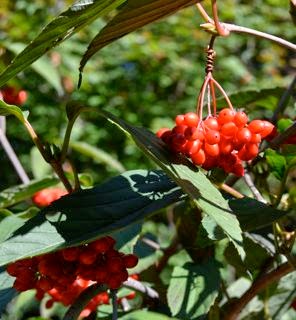
Tea viburnum (Viburnum setigerum) is a plant I uncovered at the edge of my garden in the tangled wood. It will be interesting to see what will eat the berries of this non-native plant. Right now I am enjoying this shrub’s ornamental properties and I am assuming insect pollinators were responsible for these gorgeous red clusters.
|

