Pages

Showing posts with label flowering dogwood. Show all posts

Friday, December 15, 2017

A Restorative View


Through a window I can view subtle changes in the garden with seasons and the weather as I complete my morning ritual. I notice when the leaves hang on longer in an unusually warm autumn.  And when the leaves have fallen I see a distant knothole through tangled branches of sassafras and dogwood. It is a hole in the bark of an oak where a branch used to be. I wonder what might live or seek shelter in there. Throughout the winter months I search for clues in the bare canopy. Could it be a downy woodpecker, a tufted titmouse or a black-capped chickadee? I often see these birds as they perch in the sassafras to hammer open a sunflower seed they have taken from the bird feeder.

When snow falls the trees have sleeves of white and frozen fluff settles in crooks and elbows. As birds flitter about they release clouds of white powder. Squirrels sit all puffed up against the cold, front paws curled as in a muff, their tails a fur wrap held close to their backs. When snow melts on a bright cold day in February, I notice the patterns in grainy bark and swelling buds against a pale blue sky. During a rain shower in March, gray-green lichen brings color and every twig glistens with water droplets. 


In April there is a red blush in the canopy as maples bloom. Mid-month a strong staccato warble can be heard. The house wren returns to claim its territory amongst the flowering boughs of dogwood and lime green sassafras blossom. The woodland is colored with unfurling leaves and the soft browns, beiges and ochre of oak. I witness avian drama in May. A great crested flycatcher dive-bombs the window from the sassafras tree. Is it fighting its own reflection perhaps? The wren builds a nest in the nesting box. This fierce little bird scolds marauding blue jays. Its mate is seen frequently returning to the box with caterpillars in its beak to feed a growing family.


The leafy green of summer is a restful backdrop to my ritual. The canopy closes in and blocks much of my view. The wren’s family fledges and sometimes it makes another brood. It seems that the Carolina wren sings more stridently once the house wren has flown south. The dogwood tree turns first in fall. A mauve seeps through its leaves and grey twigs hold next year’s flower buds, which remind me of Hershey’s Kisses. Peak fall color is heralded with the oranges, pinks and yellows of sassafras leaves.

Often in the fall, the drone of a leaf blower disturbs my meditation and I wonder why anyone would blast away leaves that sustain such a beautiful natural cycle. At the very least, a view through a window affirms my faith in nature. 


Saturday, October 5, 2013

Berries for Wildlife's Winter Table


Goldenrod flowers are fading to brown from gold, but berries are now ripening and readying for wildlife’s winter table. I searched around my garden to see what is on offer. The young Winterberry holly (Ilex verticillata) plants have large clusters of shiny red berries. They will persist well into winter and cheer the winter landscape while providing sustenance for the northern mocking bird, the American robin and the brown thrasher.


The flowering dogwood tree (Cornus florida) in my garden is not in the best of health, but it hangs in there and produces brilliant red berries, which will feed the northern flicker, the yellow-bellied sapsucker and the eastern towhee. 


Pokeweed (Phytolacca americana) is a robust weed that people love to hate, but I let it grow in the wilder parts of my garden. In the Fall it comes into its own when it sports clusters of juicy, purple berries on magenta pink stems. The berries provide sustenance for migrating birds. This plant has been used for dye, ink for the pen that signed the Declaration of Independence and a spring vegetable, which is high in vitamins A and C. In southern states young shoots are canned and sold as “Poke Sallet”. All other parts of the plant, including the berries, are poisonous.


Red chokeberry (Aronia arbutifolia) produces tiny little red apples (it belongs in the apple family). This is a very tart fruit, which will persist on the shrub and provide winter interest in the garden before becoming palatable enough for a late winter feast for birds.


False Solomon’s Seal (Maianthemum racemosa) looks a little bedraggled this year because we have had little rainfall lately. This plant grows in the shady wilder parts of my garden and usually at this time of the year it has golden yellow leaves and plump red berries, which are relished by birds.


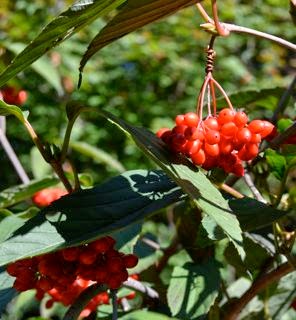
Tea viburnum (Viburnum setigerum) is a plant I uncovered at the edge of my garden in the tangled wood. It will be interesting to see what will eat the berries of this non-native plant. Right now I am enjoying this shrub’s ornamental properties and I am assuming insect pollinators were responsible for these gorgeous red clusters.


Wednesday, May 1, 2013

May Day Greening


Sassafras Flowers

I celebrate this day of fertility rites, workers rights, May queens and maypoles by embracing all that is vernal in my tangled wood and garden: the large bumblebees that roam for nectar; the promise of herbaceous perennial shooting skyward; fiddleheads and knobs of ferns as they too awaken; bird sounds all; dried oak leaves to crumble; spicebush and maple-leaf viburnum defying ivy.

The woodland canopy is colored with green unfurling leaves and the soft browns, beiges and ochre of oak flowers. The house wren has returned. It has been singing loudly and can be seen flitting amongst the lime green sassafras blossom.

 The storm-damaged dogwood tree seems more fragile than ever. But its boughs will support the nesting boxes for at least another year. Its emerging leaves appear v-shaped amongst tentative flower bracts. Springtime brings me hope and energy. 

Flowering Dogwood (Cornus florida)


Sunday, April 22, 2012

House wren territory

The house wren has returned to claim its territory amongst the boughs of the flowering dogwood tree. Both bird and tree are putting on quite a show. The strong, staccato warble of the tiny bird can be heard throughout the day. On the tree, greenish-yellow flowers are encircled by four heart-shaped bracts, massed in layers of white that float in the breeze and seem to be especially vibrant at sunset or on this overcast, rainy day. The much-needed rain is a relief permitting the tree canopy to leaf-out as spring green. Virginia creeper vines are also coming out of winter hiding.