Pages

Showing posts with label pokeweed. Show all posts

Saturday, October 5, 2013

Berries for Wildlife's Winter Table


Goldenrod flowers are fading to brown from gold, but berries are now ripening and readying for wildlife’s winter table. I searched around my garden to see what is on offer. The young Winterberry holly (Ilex verticillata) plants have large clusters of shiny red berries. They will persist well into winter and cheer the winter landscape while providing sustenance for the northern mocking bird, the American robin and the brown thrasher.


The flowering dogwood tree (Cornus florida) in my garden is not in the best of health, but it hangs in there and produces brilliant red berries, which will feed the northern flicker, the yellow-bellied sapsucker and the eastern towhee. 


Pokeweed (Phytolacca americana) is a robust weed that people love to hate, but I let it grow in the wilder parts of my garden. In the Fall it comes into its own when it sports clusters of juicy, purple berries on magenta pink stems. The berries provide sustenance for migrating birds. This plant has been used for dye, ink for the pen that signed the Declaration of Independence and a spring vegetable, which is high in vitamins A and C. In southern states young shoots are canned and sold as “Poke Sallet”. All other parts of the plant, including the berries, are poisonous.


Red chokeberry (Aronia arbutifolia) produces tiny little red apples (it belongs in the apple family). This is a very tart fruit, which will persist on the shrub and provide winter interest in the garden before becoming palatable enough for a late winter feast for birds.


False Solomon’s Seal (Maianthemum racemosa) looks a little bedraggled this year because we have had little rainfall lately. This plant grows in the shady wilder parts of my garden and usually at this time of the year it has golden yellow leaves and plump red berries, which are relished by birds.
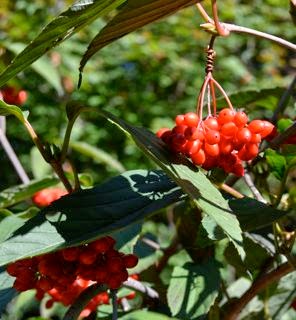

Tea viburnum (Viburnum setigerum) is a plant I uncovered at the edge of my garden in the tangled wood. It will be interesting to see what will eat the berries of this non-native plant. Right now I am enjoying this shrub’s ornamental properties and I am assuming insect pollinators were responsible for these gorgeous red clusters.


Tuesday, July 17, 2012

A Battle of Natives


I endeavor to keep a woodland clearing free of invasive plants hoping to build a pond in this partly sunny area. Gone are the multiflora rose, English ivy, and oriental bittersweet, although the wisteria vines are still persistent. In their place there is pokeweed (Phytolacca americana), Virginia creeper (Parthenocissus quinquefolia) and young sassafras trees (they grow so fast!). This time of year when the pokeweed towers above me I am goaded into action with fork and shovel to dig up its thick taproots before the flowers ripen to berries and spread the plant even more. I actually love this plant in the fall with its vivid pink stems and dark blue berries, which feed migrating birds. I let it go in other areas but here I need to keep it under control or it will be impossible to dig for the pond. It seems that when land is cleared of invasive plants the natives take over with exuberance. Virginia creeper is providing a thick ground cover and will even climb up the pokeweed. Nearby is broadleaf enchanter’s nightshade (Circaea lutetiana), which is another tall native perennial weed that forms dense cover. On the underside of its leaf, amongst the white fluff of woolly aphids, I came across a strange looking insect I have never seen before. The case bearer leaf beetle (Neochlamisus sp.), a larva in this instance, covers its body with its own fecal matter and it appears as a large blob of insect frass on stumpy legs. 

Cicada on "vacationing" Sansevieria

To herald in the season of chirping crickets, strident katydids and buzzing cicadas, I found a cicada resting on a mother in law’s tongue plant (Sansevieria) that is “vacationing” on my front porch. This was a good chance to get up close and personal with an insect I usually only hear as its sings way up in the tall trees on a hot summer afternoon. This was a fresh unblemished specimen, with huge brown eyes and margins of emerald green on its wings matching the plant’s stiff leaves, from which also dangled the dried brown case of its previous skin. Houseplants can be habitat too.