Pages

Saturday, December 28, 2013

Winterseed


Leaves have fallen but seeds persist amongst white fluff, dark brown cones or beaded along erect and bended stem. The birds have pecked some clean leaving gray skeletons and little straw-like stars. The color palette ranges from white through pink to beige. Beneath is a carpet of brown oak leaves through which robins and white-throated sparrows scratch and peck for grubs and spilled seed. Nature, left to its own devices, creates this muted beauty in a winter’s garden. A garden left alone to complete a life’s cycle. No power tools are necessary.

 Rake versus Blower

The wind rustles the trees and birds twitter from bare branches. 
Rake scrapes in a steady rhythm and pushes golden leaves into a rough and tumble pile.

Blower makes its own wind. 
A deafening roar that coerces nature’s bounty to be tidied up and put out of the way.


Using rake is wholesome exercise. 
Blower makes it all a chore.

The fuel for rake is from burning calories. 
A human body is warmed in the cool crisp air, which has the sweet smell of fall. 

Blower burns fossil fuel. 
A motor becomes hot and releases toxic fumes.

Rake caresses red leaf of maple, orange mitt of sassafras and leathery brown of oak.
Blower makes all a blur and a whir.

Neighbors stop for a chat when rake is in operation.
Doors, windows, blinds, and ears, are closed and covered when blower blows.

Rake makes free mulch that feeds the soil.
Blower leaves behind a blasted bare earth and long rows of leaf bags.

Robins and sparrows scratch and peck for food once rake is put away.
A naked soil must bear winter’s wrath after blower has done its job.

Rake has the last word.


Wednesday, October 30, 2013

Milkweed and the Tale of the Mummy

Oleander aphids on milkweed

The leaves on the milkweed plant (Asclepias syriaca) in the meadow are shriveling to yellow and crinkly brown. Yet upon closer inspection there is still some life along the plant’s folds and stems. A milkweed bug (Oncopeltus fasciatus) avoids my gaze and moves to the underside of a leaf and along the stem there are clusters of Oleander aphids (Aphis nerii) being farmed by tiny red ants. The aphids have an orange color, because just like the larvae of the milkweed beetle and monarch butterfly caterpillar, they acquire glycosides from the milkweed sap, which renders them toxic to predators. The ants protect the colonies of aphids because they feed off the honeydew, which is secreted by the tiny black tubes, or cornicles, on the aphid’s rear ends. With the first frost the aphids, ants and beetle will be gone and the milkweed plant will wither and retreat into the ground. Even if I had discovered these aphids during the growing season I would have left them well alone as a wasp parasitizes large numbers of them. Female wasps (Lysiphlebus testaceipes) lay their eggs in aphid nymphs. As the parasitoid wasp develops and consumes the insides of the nymph the aphid’s body turns color. The wasps finally emerge leaving behind brown papery mummies. Infestations of aphids on plants that are more ornamental are dealt with a soapy spray. But in this wildlife habitat garden I let nature take its course and leave the parasitoid wasps to do their thing.


Saturday, October 5, 2013

Berries for Wildlife's Winter Table


Goldenrod flowers are fading to brown from gold, but berries are now ripening and readying for wildlife’s winter table. I searched around my garden to see what is on offer. The young Winterberry holly (Ilex verticillata) plants have large clusters of shiny red berries. They will persist well into winter and cheer the winter landscape while providing sustenance for the northern mocking bird, the American robin and the brown thrasher.


The flowering dogwood tree (Cornus florida) in my garden is not in the best of health, but it hangs in there and produces brilliant red berries, which will feed the northern flicker, the yellow-bellied sapsucker and the eastern towhee. 


Pokeweed (Phytolacca americana) is a robust weed that people love to hate, but I let it grow in the wilder parts of my garden. In the Fall it comes into its own when it sports clusters of juicy, purple berries on magenta pink stems. The berries provide sustenance for migrating birds. This plant has been used for dye, ink for the pen that signed the Declaration of Independence and a spring vegetable, which is high in vitamins A and C. In southern states young shoots are canned and sold as “Poke Sallet”. All other parts of the plant, including the berries, are poisonous.


Red chokeberry (Aronia arbutifolia) produces tiny little red apples (it belongs in the apple family). This is a very tart fruit, which will persist on the shrub and provide winter interest in the garden before becoming palatable enough for a late winter feast for birds.


False Solomon’s Seal (Maianthemum racemosa) looks a little bedraggled this year because we have had little rainfall lately. This plant grows in the shady wilder parts of my garden and usually at this time of the year it has golden yellow leaves and plump red berries, which are relished by birds.


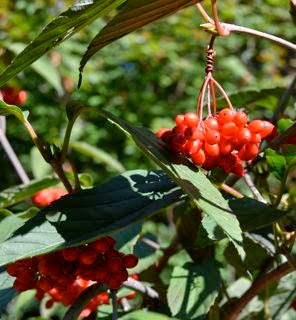
Tea viburnum (Viburnum setigerum) is a plant I uncovered at the edge of my garden in the tangled wood. It will be interesting to see what will eat the berries of this non-native plant. Right now I am enjoying this shrub’s ornamental properties and I am assuming insect pollinators were responsible for these gorgeous red clusters.


Saturday, September 21, 2013

Front lawn transformed into habitat

September 2013

A habitat garden shows its true worth at this glorious time of the year. Bumblebees, many kinds of solitary bee, predatory wasps, locust borers, tiny flower flies and countless insects (I am only just beginning to know how to identify) are in a feeding frenzy on goldenrods and asters. Flowering grasses are pollinated for copious seed. Butterflies sip the last supplies of nectar. I feel the sun’s warmth and the sheer energy of color and movement as I stand nearby and just watch.

Compare the scene above with the ivy-covered “desert” of three years ago. The front lawn was already over-run and suppressed with English ivy, where the swathe of invading green seemed all the more somber from a lack of biodiversity. I have pulled and rolled up many bags-worth of tenacious tendril to restore this area. I think you will agree that my efforts have paid off.

September 2010


Sunday, August 11, 2013

Nectaring

There is such activity and “buzziness” in the midday sun. Countless bees are nectaring from the hollow-stemmed Joe Pye weed. Wasps and flower flies are attracted to the nectar of bronze fennel flowers and the swallowtail butterflies have discovered the butterfly weed. On the pale pink blossom of Joe Pye weed there are too many kinds of bee for me to identify. I can differentiate the bumblebees, the honeybees, carpenter bees and metallic green sweat bees, but there are many more visitors of all shapes and sizes. I am a little disturbed not to have seen any monarch butterflies visiting the garden this summer. But the leaves of the common milkweed plant have been nibbled upon. The butterfly weed has only just bloomed and the sight of the spicebush swallowtails and an eastern tiger swallowtail heartens me. The cheerful sound of goldfinches delights me. They sit on the coneflowers and tug at the seed singing all along. I creep to get a good close up photo, but the birds always dash away leaving flower stems bouncing.

Sunday, July 14, 2013

Ode to an Oak

I have been overcome with sadness and guilt, but the tree had to go. For many months now woodpeckers have been hammering at the bare heartwood of a large leader branch. In the fall, a huge hen of the woods mushroom (Grifola frondosa) would billow out from the trunk at ground level. These are sure signs that this tree, close to my heart and to my house, was in decay. I would have hugged this tree if I could have gotten my arms around its wide girth. There it stood, so strong and seemingly permanent, its beautiful grainy bark clearly visible from the front door window. The day the arborist arrived to take it down I felt as if I were putting a favorite pet to sleep.

I have many mature oak trees on my property, but with this mighty plant now gone there is one less to host the myriad of insects, birds and mammals that rely on an oak for survival. Now there is one less tree for the warblers to stop over during migration when they flit about and sing way up there amongst the oak blossom to feed on insects. There is such a void: one less squirrel highway and hideaway; thousands of acorns no longer produced; leaves no longer food for caterpillars of tussock moth, hairstreak, underwings, gall wasp; no more cover from which katydids and cicadas sing. A portion of shade has gone from the house. Hostas and ferns will now fry beneath. 


In the tangled wood behind our house this tree would have provided habitat for many years during its slow demise. Indeed, it is brutal to obliterate a tree from the landscape in one day and I plan to plant an oak seedling in its place but with the realization that it will take decades for such a tree to reach maturity.  I will eventually get used to the gaping hole in the canopy and a stump (albeit with a rotten core) will be a monument to the existence of a wonderful life-giving tree.

Sunday, June 23, 2013

Summer. It's about time!


Penstemon


Full moon. Summer solstice. It’s about time for blog entry!


The tangled wood is almost impenetrable and the garden is overwhelmed with weeds after the rains of previous weeks. In honor of National Pollinator Week, I searched for some pollinators amongst the flowers that seem to have bloomed late this season.
Grasshopper on Evening Primrose
I enjoy watching the activity around the penstemon. The tubular flowers fit the bees’ hairy bodies like a glove. It seems that tiny green bees like to visit yellow flowers, such as coreopsis and evening primrose. 

Hidden amongst the flowers and foliage are insects that will take front stage later in the summer, with their song and stridulations. Is that a young grasshopper on the primrose petal? A katydid seeks camouflage on a milkweed leaf.


Katydid on Milkweed Leaf